Friday, November 02, 2007

Waiting Out Noel In Hampton

We have extended our stay in Hampton to wait on the weather. Once we enter the ICW, we will need enough good weather days to carry us through Albemarle Sound and the Alligator River. We are really enjoying our stay here. This is a very cruiser-friendly town. While out shopping for groceries, we had two offers for rides back to our dinghy. It was only a 1/4 mile, so we declined, but the offers were much appreciated. A few years ago, while on vacation, we stayed in Hampton for a couple of days. This was early in our planning (dreaming) for this trip, when we could only imagine ourselves anchored off the downtown area. Wow, and now we are here. Pictured are opposite views - downtown Cousteau Society from Ariel and Ariel from the Cousteau Society.


 Cousteau Society from Ariel

 Ariel from the Cousteau Society


We really needed the time to get caught up. We found a really neat area on East Queens Way with several boutique-type shops and neat restaurants. We both had crab cakes one last time at the Taphouse before leaving the area. We recommend this place.

Yesterday, we set out a second anchor in advance of the high winds as we are pinched between a large high-pressure system moving in and Hurricane Noel, which is moving up the coast. With Noel now upgraded to hurricane status, the winds are expected to gust to 60. This morning (Friday), we reduced our windage by removing our dodger and connector to the bimini. We also added a third anchor. We put out our Fortress FX37, which is our storm anchor. We should be able to get going again on Sunday.

Wednesday, October 31, 2007

Last Stop Before ICW

We really enjoyed our weekend in St. Mary's. It is well off the path of the southbound cruisers, so we had the place to ourselves. We stopped in at the college and, while there, bought some groceries at a small store in one of the campus buildings. We considered lunch in their cafeteria, but our appetites weren't ready for the all-you-can-eat pricing plan. The selection looked great, though. The weather did not permit touring St. Mary's City, which is a reconstruction of the original settlement. We have put this on our list of places to return to. They held small sailboat races both weekend days, with St. Mary's hosting Salisbury University.


Leaving St. Mary's, we saw our first pelicans on the Potomac River. There were actually several, and they were busy feeding. We hadn't realized that they were this far north. We stopped in Deltaville after leaving St. Mary's. We are not so sure we will return there.  We ran aground on the way in. Norm was desperately trying to locate the next red buoy when we came to a stop. At least it gave him time to get his bearings. We go so slow in these situations that it was just a nudge, and we were able to back off. The next morning, we left at low tide and ran aground in the channel. We took a guess and moved to the left a little and proceeded out in very shallow water. Traveling to Hampton, we were in company with at least 20 other sailboats and a few trawlers. We are now anchored in the downtown area in Hampton and plan to stay a few days, as high winds are predicted later in the week. It is very close quarters, as the anchorage is packed to capacity. We are using this time to do laundry and shop for groceries.

Friday, October 26, 2007

Rough Day But Great Location For The Weekend

While the forecast was for rain all day, we decided to move on to Deltaville. We pulled anchor at 7:30 am and, on the way out of the creek, noticed the open sign at the fuel dock with a very good price posted for diesel. It was still raining, but we got out the fenders and dock lines and tied up at the fuel dock. The problem was that no one was around. After searching for the attendant without success, we decided to leave. Just then, the attendant arrived, saying he wasn't expecting any business in the rain. After pumping about 10 gallons of the 60 or so we needed, they ran out. We should have known by then that the day was not going to go well. On entering the bay, the waves were really steep, having been driven by two days of strong winds. These waves reminded us of Lake Erie, which is also shallow. This wave pattern creates a very uncomfortable ride. We continued on and, after turning more southerly, put out a highly reefed main sail to help stabilize the boat. The winds continued to exceed the forecast, and the rain and, sometimes, fog did as well. We had been considering a stop in St. Mary's, which is off the Potomac. After a few hours of being pounded by the wind, waves, and rain, we decided a weekend in St. Mary's sounded really good. We are anchored just off St. Mary's College of Maryland. St. Mary's City is the site of the fourth permanent settlement in British North America, and was Maryland's first capital. We hope to explore both the college and the old city this weekend if the weather permits.

Thursday, October 25, 2007

Heading South Again

Solomons

Linda returned home on Monday. She was so happy to have spent time with Pamela, Scott, and Camryn, and was sad to leave, but at the same time wanted to get back. After a month at the same anchorage, we were extremely anxious to get going, but decided to stay another day in Annapolis to give Linda a day to get settled in again. The forecast for Wednesday through Friday was for rain and windy conditions. We decided to leave anyway and made the 9:00 am bridge opening. The day turned out pretty good with only a couple of brief showers. The skies were very gray, and the winds were moderate but variable. We did get in a little sailing in the afternoon. We were amazed at the number of boats on the bay with the poor conditions, but noted they were all also on southerly courses. We anchored near the mouth of Back Creek in Solomons. We were expecting to leave in the morning and, given the conditions, did not plan to go ashore. The wind increased overnight, and the morning forecast was for high winds for the next 24 hours. We decided to stay another day, so we moved further up the creek to a more protected area.
We have our new laptop now, and what a difference. Norm was just trying to push the old one beyond its ability, and it wasn't working out. Linda had quite a heavy load on the return trip. In addition to the laptop, we had repair parts and other boat stuff sent to Scott and Pamela's. We learned after the fact that the Harbormaster in Annapolis provides package receipt service (free) and that they even contact you when the package arrives. Now we know.

Friday, October 19, 2007

Go Bucks

Scott and Pamela are OSU alumni and fans, as are we.


Thursday, October 18, 2007

Repairs Complete - For Now

We have our chartplotter back, and it is working well. It should be, as it was a very expensive repair. They replaced the main processor board, which we have to believe is the most expensive component. Unlike personal computers, which support older technologies for quite some time, it is not the case with marine electronic equipment. Our chartplotter uses C-cards. These cards, which plug into the chartplotter, contain the charts and are purchased by region. Raymarine has since switched to Navionics for its chart cards, which use an entirely different format. Before investing in our chart cards last spring, we considered replacing the chartplotter with a newer model; however, at that time, it was working fine and had never had any issues, so we stayed with it. Once we invested in the chart cards, we were committed to our chartplotter. We did accomplish a software upgrade during the repair, and the problems we were seeing before the complete failure are gone. The timing of the failure worked out as we were without the chartplotter for three weeks, but since this coincided with our plans to remain in Annapolis, it was not an issue. Our backup system, which is displaying charts on our laptop that has a GPS unit attached, worked extremely well. We used this to travel from the Sassafras River to Annapolis. The drawbacks to this system are that the PC draws a lot of power (comparatively) and the display is difficult to see in sunlight.

As of right now, everything is working on Ariel, so we are good to move on after Linda returns next week.

Wednesday, October 17, 2007

What a beautiful baby

Scott, Camryn, and Pamela 


Friday, October 12, 2007

Grandma Helping Out


Linda is with Scott, Pamela, and Camryn. Norm happened to call her just as she was walking into the room to see Camryn for the first time, so he could at least hear her excitement. She will be there to help out until a week from Monday. Scott was able to stay overnight at the hospital as Linda was at their home and looking after their dogs, Dolly and Sophie. Meanwhile, back here in Annapolis, what a change in the weather. A front came through on Wednesday night with very high winds. Several boats dragged anchor in Spa Creek, but none in our immediate area. Some damage resulted, and one ran aground. Norm pulled in the anchor off the stern as the wind was from that direction, allowing us to swing around and into the wind. Last night, high winds were again forecast, so we all conferred here in our local area and decided we would all add second anchors off the bow. Norm added our Fortress FX37 at about a 45-degree angle off our primary anchor. This is our storm anchor, so he knew he would sleep well with little concern about the wind. There are no boats in front of Ariel, so he didn’t have to worry about anyone dragging down on him. He is now turning the heat on in the morning to take the chill off. Once the sun is up, it stays comfortable all day.


Thursday, October 11, 2007

Our New Granddaughter Has Arrived

She is Camryn Jayne Supelak. She was born at 2:25 pm on October 10. Both mother and baby are doing well. Camryn was born at 7 # 14 oz and 19 1/2 inches. Congratulations to new parents Scott and Pamela.


Monday, October 08, 2007

Doug From About Time Is Back

We had quite a surprise visit on Sunday, which at first had us totally confused. We heard a knock on the hull and, checking to see who was there, found Doug from About Time. This did not compute since they had left Annapolis a week ago, this past Thursday, bound for Norfolk. He had Paul and Jane, friends from Bayfield, Ontario, with him in the dinghy from I Wanda. We invited them aboard for drinks so we could sort out the story. Doug and Sharon were in the Solomon Islands when they got the call that their granddaughter was two weeks early. They reviewed the options and decided to push on to Norfolk, covering the 110 miles in one day. Sharon flew home, and Doug found a marina to put the boat up for a couple of weeks. He then rented a car to return to Annapolis. He is staying on I Wanda and now will ride home with Paul and Jane, who were in Annapolis for the boat show. They will continue on in a couple of weeks, and we fully expect to see them somewhere along the ICW. Ella Sibley is the newest member of their family. We are anxiously awaiting our call from Scott.

Sunday, October 07, 2007

Annette On Ariel

We had very special company on Saturday. Annette Newland, a long-time family friend, came to visit with her son David and his children, Katie and Matt, along with Katie’s boyfriend, Chris, for a few hours. David and his family live in Virginia, and Annette is vacationing further south on the Chesapeake. Annette had invited us to bring Ariel to their waterfront vacation property, which we really wanted to do. Still, with Pamela’s due date, we could not risk being away from the BWI airport. Not to be deterred, she decided to come to us, which is very much in character for her. We called the water taxi to bring her out to Ariel, as the step up from the taxi is much more manageable than from the dinghy. This was a very challenging visit for her, and we cannot express how much it meant to us to have Annette and her family visit. We were happy to show off our floating home. Most of us did some dinghy touring of Spa Creek and the downtown waterfront while Annette and Linda visited. Matt took over dinghy operation for the return trip and quickly mastered handling the outboard. Annette was very interested in our new sewing machine as she is very knowledgeable about sewing and sewing machines and has done similar projects herself. We think she would have liked to jump in on our sewing project herself.

Annette and Norm’s mother, Gladys, has been friends for a very long time. In 1972, Hurricane Agnes dislocated Norm’s mother from the home she was living in. She and Annette jointly purchased the land on which their homes are located. Their friendship has extended to a very special relationship between our families.

Friends Visit And Boat Show Time

This is the United States Sailboat Show week in Annapolis. This is the largest in-the-water sailboat show in the world. Many new models and products are introduced during the show. Don and Janet Leech, friends from Pittsburgh whom we knew when we lived and sailed in Ohio, were here for the boat show and to spend time with us on Ariel. We were very happy to see them and to catch up. They had a great summer with an extended trip sailing on the Great Lakes, traveling from their home port on Lake Erie up the east side of Michigan on Lake Huron to Mackinaw. They were away most of the summer and plan to do more next summer. They arrived on Wednesday, and after spending a little time visiting with them on Ariel, we went out to dinner. On Thursday, we took a dinghy tour of Spa Creek and Annapolis Harbor and saw the boat show from the water. They picked us up on Friday, and we went to the show together. All of us have been to the show many times, and our interest is in the vendors' exhibits in the tents. We passed on inspecting the boats. The crowd seemed lighter than usual to us.


A few years ago, Don bought a Sailrite sewing machine, which can handle the heavy materials used in the sails and canvas items on board. He has made many items for their boat, saving a lot of money by doing it himself. Inspired by Don’s success and that of some friends in Rhode Island, we bought a sewing machine at the show. Our first project will be a cockpit enclosure, which will more than pay for the machine in savings over the commercial price. These will be side curtains that attach to our bimini and dodger to fully enclose the cockpit from the elements. Luckily, Don and Janet had their car to haul the very heavy sewing machine back to our dinghy dock. After the show, they were on their way. Don is a Ham (Amateur Radio), and they were off to a Ham-fest later during the weekend. Once we add an SSB radio to Ariel, we hope to make contact with his rig in Pittsburgh.

Saturday, September 29, 2007

Navy Football

It got a little exciting on Friday as the front passed through. The wind picked up a little, not much, but enough to cause a boat to drag anchor. The owners were not on board. One boat in its path moved. The movement was very slow, so there was plenty of time to react. After a while, it threatened another unoccupied boat, so a few of us used our dinghies to push it back to a safe position. It turns out that they had hardly any chain out. We added more chain, and it stayed in the new position. The owners returned after dark and did a double-take when they found their boat had moved to a new location. The Navy-Marine Corps Memorial Stadium is close by, and this is the second weekend we have been here with a home game. The sound is traveling well today, so it is almost as if we were there in the stadium. Both last week and again this week, they had a military flyover during the National Anthem, and we are right on the approach path, and they are extremely low as they fly over. This is a great fall weekend, and so far, we have had little traffic on the creek.

Thursday, September 27, 2007

Exploring Annapolis

We have settled in here in Spa Creek. We moved to another location where we could put out a second anchor off the stern to keep from swinging. The traffic volume on the creek was really high on the weekend, as it is popular to cruise up and down the creek. We are almost at the end of the navigable waters, so they turn around just after passing us. We are also on the tour boat circuit. After the weekend, things settled down again. We have quite a collection in our little anchorage area. We have Canadian boats from Quebec, Nova Scotia, and Ontario, and boats from New Zealand and the Netherlands. We also have boats from Michigan, Maine, and North Carolina. We are getting to know our neighbors and getting great tips. One that really helped was finding out about the free city bus that runs to the Navy-Marine Corps Memorial Stadium. Our grocery is very near the stadium, so we took advantage of this opportunity. The family on the boat nearest us is from the Georgian Bay area in Canada. Larry and Janet have their children, Graham and Claire, on board. They are continuing their studies through correspondence courses. They have been here all summer getting the boat, which they purchased here, ready for the Caribbean. They plan to depart soon for Bermuda. From Bermuda, it is a southerly course eventually aided by the trade winds to the Caribbean. We are mixing our days with chores and exploring the city. Pictured is the William Paca house and garden, one of the most elegant landmarks in Annapolis. Constructed between 1763 and 1765, the five-part Georgian residence was built as a town home for William Paca, a wealthy young lawyer who was a signer of the Declaration of Independence. The estate is well-known for its two-acre pleasure garden featuring five terraces, a fish-shaped pond, and a wilderness garden. The one-hour tour is excellent, and we recommend it.


The William Paca house


Saturday, September 22, 2007

Annapolis


We are anchored in Spa Creek in Annapolis. Annapolis is our first real destination, and this will be our home base for the next few weeks. You couldn't ask for a better place for an extended stay. The city has 17 miles of shoreline between Spa Creek, Back Creek, and Weems Creek. The city has provided numerous dinghy docks, so usually you can tie up very close to your destination. Annapolis has always been a favorite of ours, but until now, we had always arrived by car. Arrival by boat the first time is a little intimidating. The harbor is busy and crowded, with moored boats and anchored vessels. We called the Spa Creek Bridge on VHF 13 to request that they open as scheduled on the ½ hour. We only had a six-minute wait. Spa Creek beyond the bridge is also very congested. Our plan was to anchor off Truxtun Park, well up the creek. While a bit tight, we did find a spot just off the park's shoreline. In October, the boat shows are held here, so we know this will get much more crowded. From here, Linda will be able to get a bus and then the light rail to BWI airport once Scott calls with the news of the baby. The trip down here worked out to be a good shakedown cruise, and this is a great place to correct any problems. We took our chart plotter into the shop for a software glitch we have been having. Get this: we just took the dinghy to the Fifth Street dinghy dock, walked a half block, and were at the Electronic Marine to drop off our chart plotter. After that, it was on to Market Slip and the Visitors Center to get information to plan some sightseeing. We had expected Doug and Sharon from About Time to anchor in the same area. They found us and stopped by in their dinghy. They had taken a mooring in the harbor for $150 per week. They also have a grandbaby due in mid-October. They will leave after the week and get as far south as they can before flying back to Toronto when the baby arrives.

Wednesday, September 19, 2007

Eastern Shore


We are really enjoying Maryland’s eastern shore. This is very rural with quiet anchorages. The shoreline is tree-lined, with areas of bluffs and others of grassy marsh leading up to the water’s edge and supporting much wildlife. Just beyond the shoreline, it opens into farm fields. Last evening, we passed close by an osprey perched on a pole while returning to Ariel. We are now anchored in Swan Creek near Rock Hall. This is appropriately named, as we passed a swan on entering the creek.

One of the hardest adjustments for us is getting accustomed to the shallow depths here on the bay. At times, we only have 2 – 4 feet under the keel. This is very unsettling as the margin for error is very slim.

Sunday, September 16, 2007

Learning The Bay

Our plan for Saturday was to spend a quiet day at anchor, but that was not to be, at least for the morning. After the front passed, the typical winds picked up. We found our nice, snug overnight anchorage was not so reliable after all. We slowly plowed through the mud and moved off position and closer to shore. We re-anchored two more times with no success. The 55# Delta was completely buried, and even with a 10:1 scope, it would very slowly plow through the mud. We did some research and found there are conditions like this on the bay. It was just our luck to find such a spot the first night. We then thought we would anchor up a small creek, but the entry was very narrow, and we ran aground. It is just mud, so it was not a problem, and we were able to back off and be on our way. This was enough to nix the creek idea. We then selected a spot across the river from our original location and found very good holding. The afternoon and evening were much more relaxing. Our voltage regulator has been dead since Old Lyme. We have been running the generator to power the battery charger to meet our electrical demands until we can get a replacement. While powering off the mud bar, we revved the engine higher than we normally operate it, and the voltage regulator is now working normally again.

The next day, Sunday, we decided to move Ariel further up the Sassafras River to be closer to Georgetown. We only went two miles, but it brought Georgetown into sight and made for a much shorter dinghy ride to town. We enjoyed lunch at the Harbor Café at the Sassafras Harbor Marina. The food was excellent and the portions generous. After lunch, we continued on another 1 ½ miles to Gelena to buy groceries. We are definitely getting our exercise.

Saturday, September 15, 2007

NJ Coast, Delaware Bay, C&D Canal

There are many challenges facing us, and some are more difficult than others. One that we had thought about and discussed a lot was our overnight passage along the New Jersey coast. We had never done an overnight trip before, so this was new territory for us. While anchored in Atlantic Highlands, we met Christian and Mary from I Wanda. They have been cruising since 1993, including three years in the Mediterranean. They have a wealth of knowledge and advised staying only about 1–2 miles off the coast. We adjusted our planned course to be two miles off. We waited until 1:30 pm to depart so we could be sure to arrive at Cape May in daylight. We stood two-hour watches right from the start and powered under sail until sunset. We shortened sail at sunset and motored through the night. It was an uneventful night, and we had two other sailboats within one to two miles, as displayed on the radar all night. The skies were clear, so millions of stars were visible. The casinos in Atlantic City are lit all night, so the city is visible for miles before and after passing. We dropped anchor in Cape May just off the Coast Guard training facility at 8:00 am.  We took showers and had short naps, and then shortly after lunch, picked up Doug and Sharon on About Time to go into the town of Cape May. We had seen their boat at all our anchorages beginning in Port Jefferson, and they were one of the two other boats traveling with us through the night. They are from Toronto, Ontario, and just spent the summer in Maine. After a visit to town, we compared plans for the next day over cocktails on their boat. We agreed to anchor up at 4:30 am to get out to the mouth of Delaware Bay at the right time to catch a favorable current all the way up the bay and through the Chesapeake and Delaware Canal (C&D). We are too tall to use the Cape May canal, so we had to go around the outside. There are shoals, so picking the right course is very important. We decided on the Cape May Channel, which is a middle course. Adding to the challenge was doing this at night, but with the chart plotter, we easily picked our way through. Our trip up the bay was very fast with both wind and current favorable. We had decided to anchor in the Sassafras River, again based on a recommendation from both I Wanda and About Time.  We anchored in a beautiful spot for a very peaceful night, with some much-needed rest.

Darkness is falling as we travel down the coast.


Sharing space with the big boys on Delaware Bay

Entering the C&D canal

Wednesday, September 12, 2007

9/11

Last night, as the high-pressure system moved in, the skies cleared and the visibility improved dramatically. For the first time, we could see the lights from the Varrazano Narrows Bridge and the New York skyline. Our special treat was to see the light from the World Trade Center site, sharp and narrow, shining straight up into space. The weather is favorable, so we are off later today (9/12) for our overnight passage along the N.J. coast

Tuesday, September 11, 2007

NYC From The Water

We made our trip down the East River on Monday, September 10, just a day before the 9/11 anniversary. Most of the day, we were traveling in fog and relying quite heavily on radar, but as we passed Manhattan and then the Statue of Liberty, the skies were clear. We ran very close to the shore, and it was unbelievable, taking in the sights and sounds of the city, getting into another work week. Today we are tucked in at Atlantic Highlands at Sandy Hook, New Jersey, with on-and-off showers. The weather looks very good to leave tomorrow for Cape May.


Monday, September 10, 2007

Visit To The Big Apple

While waiting for Hurricane Gabrielle to definitely move away, we decided to visit New York City. It was an easy trip, beginning with a water taxi to the town dock, then a short walk to the Long Island Railroad station, and finally a short ride and inexpensive trip to Penn Station. We had a great day in the city. The weather was nice, so everyone was out and about enjoying the weekend. From our vantage point at Top of the Rock, in addition to these great views of Central Park and the Empire State Building, we were able to view our planned trip through Throgs Neck, Hell Gate, the East Side, and out past the Statue of Liberty.


Friday, September 07, 2007

We Passed Inspection

Today was supposed to be a short routine run from Port Jefferson to Port Washington. There has been very little traffic on the sound during the week. Imagine our surprise as we saw the U.S. Coast Guard speeding toward us. It was hard to believe, but since there were no other boats, we decided we were probably their target. They boarded us for a safety inspection. We actually welcomed the inspection; they were cordial, and we had no violations. Later, as we approached Manhasset Bay, we could see the New York City skyline, and what a sight. We picked up a Port of Washington town mooring, which is free for the first two nights. We will stay the weekend and make our plans for the coming week.

Thursday, September 06, 2007

We Are Off

We are on our way. We had planned a Labor Day departure, but on Sunday, our work was done, the weather was perfect, and we just couldn’t resist another great sailing day on Narragansett Bay. We anchored that evening at Dutch Harbor. On Monday, we continued on to Block Island, which was our planned original first stop. We always enjoy Block and have not been there this summer yet. It was quite breezy, so we did not go ashore. Our first new stop was Old Lyme, which is on the Connecticut River. It was a quiet anchorage just past the I95 Bridge. We picked up a few groceries in town, which was a very short walk. We are now in Port Jefferson on Long Island. We are staying here an extra day before going on. We will need to slow our pace between now and the middle of next week, as the weather early next week is not favorable for our trip down the New Jersey coast.

Retired

Norm’s colleagues at Bayer and Deloitte made his last week very special. Linda and Norm drove to Pittsburgh as he needed to return company equipment and deliver their car to their daughter in Ohio for storage. Wednesday was his last full non-travel day. They arranged an office farewell gathering. Norm is happy to acknowledge the work of Bonnie Crawford, Lou Vitolo, Jean Sponseller, and Shelly Dulesky in putting this together and getting the word out. It was quite a day with absolutely everyone wearing badges with Norm’s mug shot taped on. Everyone was Norm for the day. Norm arrived to be greeted with Norm face cutouts held up in front of everyone, and of course, the "Cheers" greeting of “NORM”. We had good fun with the usual complement of gag gifts. Norm was so happy to see everyone, including former colleagues he had not seen in a very long time. They had managed to sneak Linda in, and she was also hiding behind a Norm face. Norm so much appreciates that they included Linda. The day was capped off with dinner at Monterrey Fish Grotto on Mount Washington overlooking the city of Pittsburgh. This was a smaller group hosted by George Bartha. The food was good, the wine was good, and the conversation was great. We all had a great time. Norm’s manager, Jim Bertino, was out of town for training and could not attend, but Jim had set the wheels in motion for a great last week for him, and he very much appreciates that. Throughout the week, he received well-wishes from throughout the company.

Friday, August 24, 2007

View from the top

Norm made his third trip up the mast this summer to replace the mount for the TV antenna. He designed and built this new mount as the original was obstructing the anchor light as viewed from the rear. This was to be a simple task, but one of the screws was frozen in place. He finally took a saw up and cut the screw head off.  He spent nearly an hour doing this, as every task is much more difficult suspended in a climbing harness. As he has mentioned before, he uses an ascender, which is typically used in caving, where the need is to climb back out after descending. This has worked really well as he uses his own power to ascend. He is also attached to a spare halyard, which Linda keeps tight using a winch. When he is done, he detaches the ascender and gets a free ride down as Linda lowers him. Note the tight spacing between boats. This really sharpens the skills when returning to the slip. Norm drops the main sail, which is visible on the deck, when going aloft. He actually attaches to the main sail halyard for the climb.


Tuesday, August 14, 2007

Away from our slip - finally

We finally got Ariel away from our slip. We really expected to spend many of our weekends this summer away from the slip, but that part of our planning did not go at all like we expected. It was a short trip to Dutch Harbor in Jamestown, RI, for just one night at anchor. It was peaceful and provided for some much-needed relaxation. We started the water maker for the first time, but had to shut it down immediately. It seems Norm missed installing one short but critical connection. We ventured into Jamestown to visit a dive shop. We found the dive shop, and Norm placed an order for a wetsuit. After it comes in, he will test it in their on-site pool and also add a weight belt to the order.

After returning to our slip, Norm corrected the missing connection on the water maker, and we decided to test it there because the water looked very clear. This time we did much better. He had to tighten a couple of clamps, but after that, we let it run for two hours, which topped off the water tank. Next weekend, we plan to anchor again and run it for several hours, as the tank will be near empty by then.

Norm finally ascended the mast again this week to replace the broken VHF antenna. That change went amazingly well. We are in really good shape to leave at this point, other than stocking food provisions. At this point, we are targeting Labor Day to set off on our adventure. We assume everyone else will be returning from Block Island that day, so the crowd will have dissipated. Of course, the weather will be the dictating factor in the final decision.

Tuesday, July 24, 2007

Visting family and friends

The pace is pretty quick right now. We are trying to maximize our time with family this summer, so we were off again. We had a flight to Cleveland on Saturday and spent Saturday night with Scott and Pamela. Scott surprised me with four new baseball hats with the IP star embroidery. We have adopted this as Ariel's logo. Norm was planning to ask him to have some more made, but he beat him to the punch. Sunday, we drove to Grand Rapids to visit Dan, Lesli, and Thomas. Linda spent the week, and on Monday morning, Norm drove to Mishawaka, Indiana, for project work. Mishawaka is just outside of South Bend and only a two-hour drive south from Grand Rapids. At first, Thomas was afraid of us, as he hadn't seen us since Christmas, but he warmed up very quickly. We had expected this reaction since it was the same at Christmas. Norm returned to Grand Rapids on Thursday afternoon and worked remotely from there on Friday. Both Dan and Lesli work, so Linda and Norm got to babysit. It was a delight to spend time with Thomas. He will be three in October, and he is very curious, bright, and, of course, energetic. On Saturday, we were on our way back to Ohio early for a planned lunch with our friends John and Linda Piper. John and Linda just finished almost two years of cruising. Over the years, we all exchanged ideas as we planned the live-aboard cruising life. They just bought a condominium back in Ohio, where they started. It is hard to believe they are moving back on land, and we haven’t even left yet. They made two trips south, spending much of the first winter in Charleston, SC, and the second in Florida, most of it in Fort Myers. Later in the day, we stopped to visit Kim, Jason, Michael, and Evelyn in Avon Lake. We couldn’t stay long because we were supposed to be dog-sitting for Scott and Pamela, and we were running late. We will be back in Ohio in two weeks, so we didn’t feel too bad. Sunday morning, we visited briefly with Scott and Pamela, but they were exhausted after returning late from a wedding reception the night before. A little before lunch, we were off to the airport, and arrived back on Ariel at about 8:00 pm after checking on the house on the way. While we enjoyed the week, we were also glad to be home again, although only for three nights this time before we are off again.

Thursday, June 28, 2007

Its's a lifestyle

We're surprised by the reaction we get when people first learn about our plans. Understandably, people who have not had exposure to the live-aboard cruising lifestyle have no basis for forming a picture of what this really means. In fairness, like anything else, there is a wide range of options.

For us, this is our home, and we wanted the conveniences to which we have grown accustomed. Our last boat, by comparison, was more akin to camping, which was acceptable for weekends and the one or two-week vacation cruises. We decided to outfit Ariel as comfortably as we could. We decided that if something was a minor irritant at the marina or at a weekend anchorage, it would become a major annoyance when living aboard full-time.

We have heat and air-conditioning that function exactly like those in any home. We set the thermostat or program it and forget about it. We have both hot and cold pressure water, with a double-bowl sink in the galley. Okay, the sinks are much smaller than those found in most homes. We do not have an automatic dishwasher. We do have a three-burner propane stove with a thermostat-controlled oven, which bakes very well. Rounding out the galley are a freezer and a refrigerator.

We have a single head (toilet) and a spacious shower. The head area includes a full-length mirror. Our berth is about queen-sized and extremely comfortable. The guest berth is full-sized.

We have comfortable dining in both the main cabin and the cockpit. We also have a gas grill we can use off the stern rail.

Yes, of course, there are trade-offs compared to living in a house. One is that while we have adequate storage, things are often not at our fingertips. It usually requires removing a cushion to gain access and may require some digging around. It is also important to put things away immediately. Our space is very limited, so it can become cluttered very quickly. If something is left out, it will invariably be in the way of accessing the next needed item. Everything must be secured before we get underway, so it is just easier to keep things that way as much as possible.

We do not have a clothes washer and dryer. Just think about how much space, water, and power these would consume. The other big adjustment from life on land is that we do not have a car. Shopping has to be well-planned, as everything needs to be schlepped back to the boat by whatever means are available.

Overall, we believe Ariel is very comfortable. We have spent enough time on boats that we know how to respect each other's space. It is not hard to find a quiet place to read, work on the computer, or just take in the natural surroundings. We split the workload pretty evenly, so we both have comparable amounts of leisure time. It helps that we have many common interests and have long enjoyed doing things together.

The real reward is that no matter where we travel, we have our home with us

Wednesday, May 16, 2007

New Memorial Day Plans

We are changing plans again. We had planned to get away Memorial Day weekend to anchor at Dutch Harbor near Jamestown, RI, but changes to work travel requirements prodded us to rethink this. Norm was already scheduled to be in Pittsburgh the week before the holiday weekend, and now he also needed to be there the week after. We will use this as an opportunity to visit family, by driving to Pittsburgh, spending the holiday weekend at Norm’s mother's, on the way, and then visiting our children and their families in Ohio at the end of the following week.


We took delivery of the dinghy and outboard and have already registered them. The 15 hp outboard is a handful at 113 lbs. We are adding a lifting crane, as using a spare halyard has not worked well for us.  Trying to handle it as we did with our 5-hp Mercury will not work without someone getting hurt or losing the motor. We also had our holding tank system inspected. This is a new requirement in Rhode Island. Linda made good progress scraping the old finish off the teak after we picked up some new blades.

Wednesday, May 09, 2007

We Are Launched

Last week, Ariel was launched, right on schedule. We spent the weekend and Monday aboard. When getting ready to clean the deck, we discovered a bird's nest built between the anchor rollers. We waited to see if the parents were around, but it soon became apparent that they did not follow Ariel's travels from the boatyard to our slip. If they had been around, we would have left the nest in place, but without the parents, Norm removed the nest and got on with cleaning the winter grime from the deck. Saturday was very nice, so we got a good start getting the boat ready. We were able to get the dodger and bimini on and finish cleaning the cabin areas. We are still moving things around, trying to find the best storage arrangements.

We stayed on Monday to test our internet connections and Norm’s ability to work from the boat. The marina has a wireless system (for a fee), which we subscribed to. Bottom line, he was able to work quite well from the boat. The wireless connection is actually faster than the DSL service we have at home.  We subscribed to a second service for our personal laptop and used Skype for business calls. The work area in the guest cabin is comfortable, quiet, and Norm was not distracted. Linda spent much of the day scraping the finish off the teak caprail.

Wednesday, April 18, 2007

Getting Ready for Launch

The weather has been horrible for working on the boat. The priority is getting the bottom paint on so Ariel will be ready to launch. Bottom paint has a high copper content and includes biocides that resist marine growth. We use an ablative paint which slowly wears away. Since we will not have the boat hauled again until 2008, we want to give extra special attention to getting the bottom right. We haven't been able to work outside, so Norm decided to proceed with the watermaker installation.

It took three weekends, but the watermaker installation is now complete. It will be quite a while before we can test it. Until we are ready to run it on a routine basis, it cannot be started. This system has several components that can be installed in separate locations. The final design is not much like Norm’s original plan, but his original plan was done away from the boat, and his memory of the dimensions of some spaces was a bit off. He is pleased with the result; it is very efficient, with all components installed close to one another and very close to the electrical and water connections. The only concern he has is that the module is mounted upside down on a shelf, so it is hanging. This was to keep as much usable space as possible. The concern is that, if necessary, repairs will be very difficult, and anything stored in this area will need to be protected against potential water leaks. Routine maintenance, such as filter changes, should be fairly easy.

We are also busy taking things to the boat. With the house sale closing date set, we have to make the final decisions soon as to what stays and what goes. We're in good shape with the final choices around clothing and kitchen items. We have had some strange dishes lately as Linda is cleaning out the cupboards.

Sunday, April 01, 2007

Getting the Covers off Ariel

We expect to sign the Purchase and Sale Agreement on our home on Monday, April 2, so we are really feeling the urgency to get Ariel ready to launch. We are both anxious to get the preparation work behind us and have our new home ready when we close. To that end, this past weekend, we removed the winter cover protecting Ariel. We were pretty efficient, as this was the fifth winter we have used this cover. The day was perfect with temperatures in the 50s and a clear blue sky.

Each year at the end of May, Defender Marine, a discount marine store, holds a four-day warehouse sale that extends online. They already have good prices, with no sales tax and reasonable shipping, so the sale is really nice. Norm has the patience each year to compile his list and wait for the sale. This year, we ordered all of the electronic charts to cover from New England to the Bahamas. These are on tiny cards that slip into our chartplotter at the helm, or into a card reader attached to the laptop. We can do our route planning on the laptop and then transfer the cards, both the chart and a user card with our route plans, to the chartplotter. We also ordered paper chart kits and guides for the same areas. These provide a broader view and, most importantly, backups to the electronic version.

We also purchased bottom paint and updated signal flares. These have expiration dates, so they need to be replaced periodically. As soon as we get another nice weekend, we will apply the bottom paint, and then we will be ready for launch.

Friday, February 09, 2007

Selling Our Home

This adventure is really getting exciting now. Our home is now listed, and the open house is scheduled for this Sunday.  This is one part of preparing we have limited control over, especially the timing, but we'll go with the flow.


Sunday, January 28, 2007

Refrigerator / Freezer Upgrade

The box for the refrigerator and freezer compartments is very large, and the back wall is inaccessible without climbing into the box itself. During commissioning, we added a Frigoboat keel-cooled system, and we have been extremely happy with it. This system circulates the refrigerant to a heat exchanger plate attached to the hull and in contact with seawater. There are no fans with this system, so it is very quiet, and the heat does not build up in the compartment where the compressor is mounted.


Our goal has been to keep the freezer side of the split box at about 0 degrees and the refrigerator side at about 40 degrees. The evaporator plate is mounted in the freezer compartment. The refrigerator side is cooled entirely by spillover from the freezer side. We concluded after operating for a couple of seasons that the box insulation was insufficient, requiring the compressor to run more often. Many other Island Packet owners have experienced the same in many different models. It is my understanding that the manufacturing process on newer models has been changed to minimize the incidence of voids in the insulation. We found a site that sells components for refrigeration systems, including box construction materials. Since the box was oversized, we decided we could add insulation to the interior without a significant loss of space. We also did not want to remove or alter the countertop in any way. This meant working within the box, which would prove very challenging. We ordered 1-inch-thick vacuum panels, which were custom-made to our specifications. The box is an irregular shape, so all panels have some angles. They also had to be sized to fit through the access opening. The vacuum panels must be handled carefully and well-protected, as any puncture will greatly reduce their effectiveness. The panels have an R-value = 28. To protect the panels and provide a new interior surface, we ordered sheets of protruded fiberglass. We then cut pieces to form a new interior. Construction then involved gluing the vacuum panels in place using insulation foam, and then gluing the fiberglass sheet over the panels, and finally using an epoxy putty to seal all joints. The insulated divider between the freezer and refrigerator compartments was removed, cut down on each side to the new dimensions, and then refitted. While it was out, we added an electric spillover fan, which is controlled by its own thermostat.


One last upgrade was to add an electronic module to control the compressor. The objective is to run the compressor at the slowest possible speed. It is more efficient to run it slower for longer periods of time. Depending on the demands, this module adjusts the compressor speed to achieve this objective as much as possible. It also has a manual override that can be used to cool faster, such as when restocking.

After one season with the upgrade, we are very happy with the result. We probably did not need the spillover fan, and subsequently, we added a butterfly value to adjust (slow down) the air flow. Once cooled down, we usually close the butterfly valve almost completely.

Saturday, January 13, 2007

Survival

Our first and most important step toward survival is preparation, planning, and giving full consideration to the weather and conditions. That aside, there are always the unknown factors or circumstances. For this, we have our survival equipment and plans. These we view much like insurance. We need it, but we hope we never have to use it. Also, like insurance, this equipment provides peace of mind to have it available.

EPIRB – this device is registered with the FCC. If we activate it, it will send a signal that reports our position from an internal GPS and identifies us as the sender. In all likelihood, either our son Daniel or our daughter Pamela will be contacted, as they are registered as our contacts. Once they confirm we are, in fact, at sea, a search team will be deployed to our reported location. Given the swiftness of the potential recovery by activating the EPIRB, we consider this a very important piece of equipment.

Life Raft – We have a Winslow 4-person model 40SLO, which weighs about 41 pounds. We had it vacuum-packed so it can last for 3 years before inspection and repacking, rather than the normal annual inspection. Some supplies packed inside the raft are dated and are then replaced during inspection.

Ditch Bag – this bag is stowed just under the companionway so that it can be easily grabbed from the cockpit, but it is actually stored inside the cabin. The bag includes essentials for survival and recovery. It includes the EPIRB, distress signals, the first-aid kit, additional food and water, and important papers, among other items. A handheld GPS and VHF radio are nearby and would be put in the bag if possible.

There are a couple of ways to stow a life raft. Some are stowed in a canister mounted on the deck or the stern rail. We seriously considered mounting a canister on the cabin roof, but in the end rejected the idea. The canister benefits from not consuming valuable storage space, but it must be securely attached to reduce the risk of being washed overboard, and it subjects the raft to more of the weather, such as the hot sun. We decided on the other available option: stowing it in a protected space, which in our case is a cockpit locker. This has the advantage of protecting the raft from the elements and also being readily available from the cockpit. The major disadvantage is giving up prime storage space. As a compromise, we constructed a shelf for the life raft, which is hinged to fold up out of the way when working in the locker and also is on a slide so the life raft can be moved directly under the locker lid, ready to be lifted and deployed.

Thursday, November 23, 2006

Setting a Date

This has actually been the hardest decision for us to make. It is a balancing act between saving for retirement and leaving soon enough to be reasonably fit and in good health. The financial advisers warn those contemplating early retirement that medical insurance until Medicare kicks in at the normal retirement age is extremely expensive.

Neither of us has retiree medical insurance. Linda lost hers when her employer totally revoked the benefit and, in its place, added a small amount to her 401(k). Norm lost his retiree medical insurance in one of the many corporate reshuffles that he otherwise survived. Norm could work just another year plus and again qualify for retiree medical insurance, but that would delay our departure by two years, since we could not leave until the fall of the following year. It sounds enticing, but the trend has been to shift more and more of the premium burden to the retiree, and we don't have confidence that the program will not be dropped in the future.

In the end, we decided not to wait for this benefit and to struggle through the gap with individual insurance plans. 

So then what happens in 2007? Norm will reach the 30th anniversary mark with his employer. This is special because he can then draw a full unreduced pension. The timing could not be better. His anniversary is in August, and we want to leave in September.

Linda is already retired. She retired when we moved from Ohio to Massachusetts. She no longer had a career as such, but a job with little opportunity for advancement. During one of the campaign periods for an increase in the local school levy, they restricted school buses to the state minimum of outside two miles from school. We lived just within a two-mile radius, so Linda gave up her position in the Trust Department and accepted a part-time bank teller position with the same employer to be closer to home and have more flexible work hours. Within a couple of weeks, bus service was resumed, but the change had been made, and she was never considered for a position in the Trust Department again. Over time, she was assigned to branches farther and farther from home. It was an easy decision to retire when relocation provided another good excuse.

Norm is not so anxious to retire as he is to pursue our dream while we can. For the last 10 years, he has been a consultant configuring SAP software. This is project work, which, by nature, is very demanding, with long hours and a high level of travel. It is also extremely rewarding as the teams, conditions, and challenges are constantly changing. If we did not have this dream, he would not even think of early retirement.

Thursday, November 16, 2006

Boat Tour – Guest Cabin

The guest cabin is on the port quarter. This features a double berth which extends under the cockpit. We have changed this area significantly from the original design. Island Packet included a small sink in a slide-out drawer under a lift-up top in the cabinet. While interesting and functional, this just wasn’t a practical use of the space for us.

We removed the sink, water supply, and drain lines. We re-routed the hot water line to the cockpit shower, which had previously been cold-water only. This involved adding a mixer in the cockpit to regulate the water temperature. We converted the sink drain through-hull to use for the generator exhaust water. We then built a teak desk that slides out just as the sink did, and it also has leaves that fold out to create a reasonably sized work area. The desk was designed primarily as a station for the laptop computer. When the laptop is not in use, it is stored safely in the desk compartment.


We finally added a chair for the desk. This chair uses a pedestal system that allows for easy removal, leaving a plate flush with the cabin sole. While guests are aboard, the chair is stored at the helm in the cockpit. 

This compartment also includes a hanging locker. While rarely used as such, this space is used to store a toolbox and a wet/dry vacuum, both of which are too bulky for other storage areas but are now readily accessible.

Sunday, November 12, 2006

Generator Installation


The biggest project we undertook was installing a generator. We get many of our ideas from the Island Packet Discussion List, a forum for exchanging ideas via email hosted by Sailnet.com, and from Islandpacketphotos.com, a site hosted by Hayden Cochran, also an IP owner. We had been searching for a small generator at a reasonable cost. We were drawn to a 4.2kw generator made by Entec West. The size and price were right, and they are very supportive of owner installation and maintenance. We made the decision and traveled to the Annapolis Boat Show to see the model in person and place our order. We immediately started creating a space for it on Ariel. We decided the best location was directly under the helm. This is on the centerline, which we felt was important since the generator with sound enclosure weighs 234 pounds.                                                                                                                                                                                                                               


This space was already occupied by the hot water heater. We took a radical approach and moved the hot water heater all the way forward to a space under the berth. It just fit through the opening. This meant re-routing the water lines and running electricity to the water heater at the new location. Normally, the water is heated from one of two sources. While the engine is running, the engine cooling system will provide heat to warm the water through a heat exchanger. The second source is 120-volt AC power, provided by shore power or a generator. The space now occupied by the hot water heater is not readily accessible, as it is under the mattress, so we felt it was an easy trade-off.

The generator needed a solid base, so during the winter, a base was constructed to beef up the existing platform that previously supported the hot water heater.

Most of the work during the installation was focused on the supporting services. A new through-hull was installed to provide cooling water. Just after the through-hull, a new strainer was installed to filter out any debris that may be drawn in. A new fuel line was required and well as a fuel return. We designed a fuel system that included a fuel filter identical to the one used to support the main diesel engine. We also designed a manifold that permits the main engine or generator to use either fuel filter. If one fuel filter becomes clogged, we can immediately switch to the other, continue on, and then change the dirty fuel filter later.  We also had to install the cables from the starter battery to the starter motor. The generator shares the same battery for starting with the main engine. We added the control panel, which is mounted in the cockpit. This particular one will shut down the generator if problems are detected, such as overheating or low oil pressure.

We added the electrical wiring, which required a set of circuit breakers to prevent sourcing 120-voltt AC from shore power and the generator at the same time. We added the exhaust system, which required routing the exhaust through a water lift muffler and then to the transom, where a new exhaust port was added. Marine engines mix the cooling water and the exhaust. We knew this would create a splashing sound, but decided to try the system one season before deciding whether we needed an air-water separator. The air-water separator does exactly what the name implies. It separates the air and water and then routes the exhaust air to the transom exhaust port and sends the water to an underwater through-hull. The following year, we added this feature. While the generator has its own very good sound enclosure, we decided to add another layer of sound insulation to the area where the generator would be installed. Finally, we lowered the generator into place, using a chain fall attached to the spare halyard. This operation went smoothly, and after making the final connections and bleeding the fuel lines, it started quite readily. We have been very pleased ever since and are very satisfied with the sound level. The unit produces 35 amperes, which can power everything we have on board, but not all at once. We added an amperage gauge at the electrical panels to monitor our consumption and the generator load. Access to the generator for maintenance is through the starboard cockpit locker. The sound enclosure is removed as shown in the first photo to provide access.

Friday, November 03, 2006

Tucked Away for Winter


Ariel is now ready for its final winter in the Northeast. It is a required ritual in the north to prepare for winter and, of course, in the spring to re-commission for another season. There is actually quite a list of tasks, all of which are extremely important to avoid damage from freezing and severe weather. We had a custom cover made in the first year we had Ariel. In addition to keeping the freezing rain and snow off, it also protects it from the sun and from boat yard hazards such as paint overspray. We remove all items that could freeze; many of these are items from the head and from the galley. We put antifreeze (pink pop) in all of the systems. The engine, generator, and air conditioning units all use seawater for cooling. This seawater has to be replaced with antifreeze. The water tank and the hot water heater are drained, and the antifreeze is run through all of the fresh water lines. This antifreeze is non-toxic, so in the spring, the lines are flushed and are ready for normal use. All other systems are also winterized in the same fashion. These include the head, wash down system, and sump pumps. We then open compartments and place cushions on end to allow air circulation. On the exterior, we start maintenance at the bottom. In the spring, we will put on new coats of bottom paint. This is paint with a high copper content, which helps prevent marine growth. The propeller (Autoprop) is greased to force out any water that may be inside the hub. We scrape the few barnacles that have accumulated. Barnacles attach to any metal surface, so the prop will have several. Once all of this is done, Ariel is pretty safe left alone. We check on things about once a month during the winter. This gives us a chance to see if any water has accumulated in the bilge, and if not frozen, it is removed. We also run the battery charger to keep the batteries left aboard topped off.

Those are the tedious details of putting Ariel away for another winter. But this year is very special for us, as this is the last time we will go through this process. The alternative to all of the above is to take the boat to a warmer climate. So stay tuned, as next year we will do just that. Now we have the long winter to endure. We will turn our attention toward cruise planning and start putting some more details around the dream.

Saturday, October 28, 2006

Boat Tour - Main Cabin


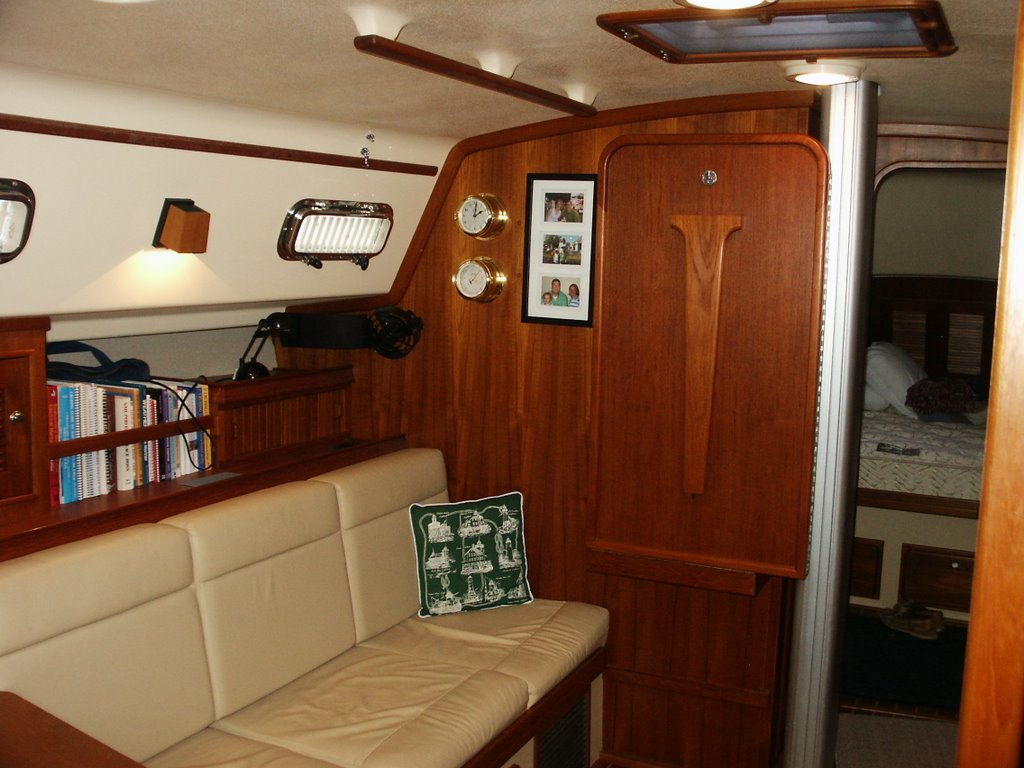
The main cabin is both our living and dining rooms. Much of our storage space is behind and under the settees. The locker on the starboard side is where we keep our foul-weather gear and our coats. In front of the locker is our laundry bag. This is one of the trade-offs, as there is just not enough space for this in any other compartment.  We have two air conditioning units, under the forward-most portion of the settees on both the port and starboard sides.


The dining table is shown below in both the up and down positions. This is a wonderful design, as it is so easy to put away when not in use, which really opens up the space. For the two of us, we use it as shown. When we have guests aboard, the table folds open again to double in size. The navigation station and chart table are just visible in the picture with the dining table in the down position. This area really doesn't get much use as we have our instruments and radar/chartplotter at the helm. Without a seat back, this area just isn't very comfortable to work at for more than a few minutes. We have solved this by adding a work desk in the guest cabin, which we will review in a future post.


Saturday, October 21, 2006

Boat Tour - Galley


The galley features a three-burner propane stove with oven, a double stainless steel sink with hot and cold water, a microwave oven, and a large refrigerator/freezer. This is a roomy space with good lighting and good ventilation. Visible in the foreground is a fold-down counter which, when up, provides additional counter space, which is at a premium. The cabin sole (floor) in this area is fiberglass and gelcoat, which makes for easy cleaning. This space is at the base of the companionway (entrance), so it is also a good area to remove wet clothing. The refrigerator/freezer box is split about 1/3 freezer and 2/3 refrigerator. We keep the freezer at 0 degrees and the refrigerator at about 40 degrees. The refrigeration unit uses seawater for cooling and does not have a fan, so it is very quiet and very efficient. One of the improvement projects we undertook was adding insulation to the interior of the box. We added custom-made vacuum panels and then a new fiberglass covering. We lost a little space, but the gain in electrical efficiency was well worth it. We keep the most frequently used items in the galley area, but food supplies are also stored in the main cabin. One nice feature, not visible in these pictures, is that the waste basket is mounted in a roll-out drawer under the galley sink. Since we have an inverter (which converts 12V battery power to normal household 110V), we use some regular appliances such as a toaster, blender, and coffee maker.


Tuesday, October 10, 2006

Boat Tour - Forward Berth


This is our cabin. It is quite roomy. The bed at its widest point is between a queen and a king. Linda makes custom sheets beginning with a king-size flat. She adds a pocket for a drawstring to tighten the sheet under the mattress. Forward, the mattress sides follow the shape of the hull, so without some way to tighten and hold the sheet, it would continuously slip off.  Just forward beyond the pillows is access to the anchor locker, where the anchor chain and rode are stored. The mattress platform is hinged in the middle, and the lower half of the bed lifts to access a large compartment we use for linens. There are also drawers under the bed and cabinets on both sides, hidden in this camera angle. There are shelves on both sides and additional lights and fans above the pillows. There is one opening hatch overhead and two port lights with shades.