The earlier sketches (12/10/2006 post) were by Linda, new to sketching. After Dan saw these, he was inspired to share one of his sketches, a talent he was keeping close to the vest.
Monday, December 18, 2006
Daniel Sketches Too
The earlier sketches (12/10/2006 post) were by Linda, new to sketching. After Dan saw these, he was inspired to share one of his sketches, a talent he was keeping close to the vest.
Saturday, December 16, 2006
Cookie Time
| Front: Linda, Mom; Back: Dale, Darlene, and Lois |
| Elizabeth (Linda's mom) |
Lois has a very successful business with her automated embroidery machines. Dale just acquired her machine this year and brought very nice tote bags for each sister and mother. Linda, very appropriately, had an embroidered anchor and line on navy colored bag, which is perfect for Ariel. Dale ended the week spending time with Lois to draw on her vast experiences with these machines.
Sunday, December 10, 2006
Friday, December 01, 2006
Interior Finish
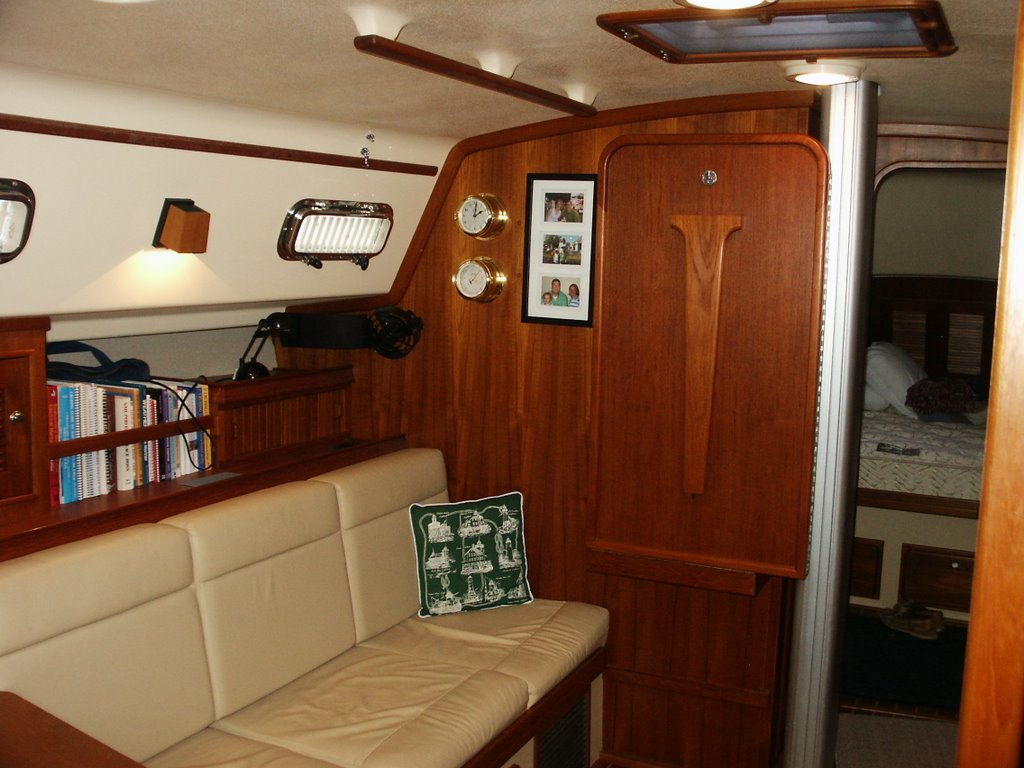
The interior finish as delivered from the factory is oil. They use Daly’s SeaFin Teak oil, which is a high-quality interior finish. The selection of teak and teak veneers is well matched for color, and the fit is extremely good, but the coating of oil provided by Island Packet was light, and the surfaces were not well sanded. Rebecca J. Whitman’s book Brightwork: The Art of Finishing Wood is excellent, and one chapter is devoted to finishing the interior with oil. She shares professional advice on varnishing and oiling techniques. When it comes to interior finishing in our home, Linda almost always is the painter, while I tackle the wallpapering. It seemed a natural fit for her to undertake the project to finish the interior, following the steps recommended in the book. This required several applications of Daly’s with wet sanding between applications with 400 grit and eventually 600 grit sandpaper. This resulted in a professional finish that highlights the beauty of the teak and provides a very smooth surface. Ongoing maintenance is very easy, just requiring one new application each year, which is applied with bronze wool.
This was the most labor-intensive project we have undertaken on Ariel. In addition to many weekends, Linda stayed at the boat for several weeks while I was away on business trips. We removed all doors and drawer fronts and took them home to our basement to be finished over the winter. Many of the doors are louvered, so the work was challenging. It is hard for even us to believe, but we, almost all Linda, invested 600 hours in this single project. It was a good thing not to know the magnitude of the project before we started, as it would have been extremely difficult to get motivated. Pictured is part of our basement converted to a teak finishing facility.
Tuesday, November 28, 2006
Namesake
The Ariel was a clipper ship famous for making fast voyages between
The Ariel was a full-rigged ship of 853 tons net register, measuring 197.4 feet x 33.9 feet x 21 feet. She was designed by William Rennie and built in 1865 by Robert Steele & Co., Greenock, for Shaw, Lowther & Maxton of London. Like most tea clippers, she was composite-built, of timber planking over iron frames.
The Ariel is most famous for almost winning an unofficial race between Foochow,
Taeping, Captain McKinnon, owned by Captain Alexander Rodgers of Cellardyke, Fife, drew less water than Ariel and was able to tie up in the
With the completion of the Suez Canal, the tea trade was taken over by steamships, and most of the clippers transferred to the Australian trade, carrying general cargo to either Sydney or Melbourne, and returning with wool, for which a premium price was also paid on the first shipments of the season.
The Ariel sailed from
Thursday, November 23, 2006
Setting a Date
Neither of us has retiree medical insurance. Linda lost hers when her employer totally revoked the benefit and, in its place, made a small addition to her 401K. I lost mine in one of the many corporate reshuffles I have otherwise survived. I could work just another year plus and again qualify for retiree medical insurance, but that would delay our departure by two years, since we could not leave until the fall of the following year. It sounds enticing, but the trend has been to shift more and more of the premium burden to the retiree, and I do not have the confidence that the program will not be dropped in the future anyway.
In the end, we decided not to wait for this benefit and to struggle through the gap with individual insurance plans.
So then what happens in 2007? I will reach the 30th anniversary mark with my employer. This is special because I can then draw a full unreduced pension. The timing could not be better. My anniversary is in August, and we want to leave in September.
Linda is already retired. She retired at the time we moved to Massachusetts from Ohio. She no longer had a career as such, but a job with little advancement opportunity. During one of the campaign periods for an increase in the local school levy, they restricted school buses to the state minimum of outside two miles from school. We lived just within the two-mile range, so Linda gave up her position in the Trust Department and accepted a part-time position as a bank teller with the same employer to be closer to home and to have more flexible work hours. Within a couple of weeks, bus service was resumed, but the change had been made, and she was never considered for a position in the Trust Department again. As time went on, she was assigned to branches further and further from home. It was an easy decision to retire when relocation provided another good excuse.
For me, I am not so anxious to retire as I am to pursue our dream while we can. For the last 10 years, I have been a consultant configuring SAP software. This is project work, which by nature is very demanding with long work hours and a very high level of travel. It is also extremely rewarding as the teams, conditions, and challenges are constantly changing. If we did not have this dream, I would not even think of early retirement.
Wednesday, November 22, 2006
Counsels from Water Rat
From The Wind in the Willows, a classic of children's literature written in 1908 by Kenneth Grahame
`This has been a wonderful day!' said he, as the Rat shoved off and took to the sculls again. `Do you know, I`ve never been in a boat before in all my life.'
`What?' cried the Rat, open-mouthed: `Never been in a -- you never -- well I -- what have you been doing, then?'
`Is it so nice as all that?' asked the Mole shyly, though he was quite prepared to believe it as he leant back in his seat and surveyed the cushions, the oars, the rowlocks, and all the fascinating fittings, and felt the boat sway lightly under him.
`Nice? It's the only thing,' said the Water Rat solemnly, as he leant forward for his stroke. `Believe me, my young friend, there is nothing -- absolute nothing -- half so much worth doing as simply messing about in boats. Simply messing,' he went on dreamily: `messing -- about -- in -- boats; messing -- -- '
`Look ahead, Rat!' cried the Mole suddenly.
It was too late. The boat struck the bank full tilt. The dreamer, the joyous oarsman, lay on his back at the bottom of the boat, his heels in the air.
` -- about in boats -- or with boats,' the Rat went on composedly, picking himself up with a pleasant laugh. `In or out of 'em, it doesn't matter. Nothing seems really to matter; that's the charm of it. Whether you get away, or whether you don't; whether you arrive at your destination or whether you reach somewhere else, or whether you never get anywhere at all, you're always busy, and you never do anything in particular; and when you've done it there's always something else to do, and you can do it if you like, but you'd much better not.
Look here! If you've really nothing else on hand this morning, supposing we drop down the river together, and have a long day of it?'
Thursday, November 16, 2006
Boat Tour – Guest Cabin
We removed the sink, water supply, and drain lines. We re-routed the hot water line to the cockpit shower, which was previously cold water only. This involved adding a mixer in the cockpit to regulate the water temperature. We converted the sink drain through hull to be used for the generator exhaust water. We then built a teak desk which also slides out just as the sink did, but also has leaves which fold out to create a reasonably sized work area. The desk was designed primarily as a station for the laptop computer. When the laptop is not in use, it is stored safely in the desk compartment.
We finally added a chair for the desk. This chair uses a pedestal system, which allows for easy removal, leaving a plate that is flush with the cabin sole. While guests are aboard, the chair is stored at the helm in the cockpit. Guests, of course, now use the sink in the single head on Ariel.
This compartment also includes a hanging locker. While rarely used as such, this space is used to store a toolbox and a wet/dry vacuum, both of which are too bulky for other storage areas but are now readily accessible.
Sunday, November 12, 2006
Generator Installation
ct we have undertaken was to install a generator. We get many of our ideas from the Island Packet Discussion List, a forum to exchange ideas via email, hosted by Sailnet.com, and from Islandpacketphotos.com, a site hosted by Hayden Cochran, also an IP owner. We had been searching for a small generator at a reasonable cost. We were drawn to a 4.2kw generator made by Entec West. The size and price were right, and they are very supportive of owner installation and maintenance. We made the decision and traveled to the Annapolis Boat Show to see the model first-hand and to place our order. We started immediately to create a space for it on Ariel. We decided the best location was directly under the helm. This is on the centerline, which we felt was important since the generator with sound enclosure weighs 234 pounds. This space was already occupied by
the hot water heater. We took a radical approach and moved the hot water heater all the way forward to a space under the berth. It just fit through the opening. This meant re-routing the water lines and running electric for the water heater to the new location. Normally, the water is heated from one of two sources. While the engine is running, the engine cooling system will provide heat to warm the water through a heat exchanger. The second source is 120 volt AC electric, which is provided by shore power or a generator. We decided not to route the hot water from the engine all the way forward, but since we now have a generator, we could produce hot water anytime from 120 volt AC electricity. The space now occupied by the hot water heater is not readily accessible, as it is under the mattress, so we felt it was an easy trade-off to make. The generator needed a good, solid base, so during the winter, a base was constructed that would beef up the existing platform that previously supported the hot water heater.
Most of the work in doing the installation was around all the supporting services. A new through-hull was installed to provide cooling water. Just after the through-hull, a new strainer was installed to filter out any debris that may be drawn in. A new fuel line was required and well as a fuel return. We designed a fuel system that included a fuel filter identical to that the support the main diesel engine. We also designed a manifold that permits the main en
gine or generator to use either fuel filter. If one fuel filter becomes clogged, we can immediately switch to the other, continue on, and then change the dirty fuel filter later. We also had to install the cables from the starter battery to the starter motor. The generator shares the same battery for starting with the main engine. We added the control panel, which is mounted in the cockpit. This particular one will shut down the generator if problems are detected, such as overheating or low oil pressure.We added the electrical wiring, which required a set of circuit br
eaker controls that prevent sourcing 120 volt AC from shore power and the generator at the same time. We added the exhaust system, which required running the exhaust through a water lift muffler and then routing it to the transom, where a new exhaust port was added. Marine engines mix the cooling water and the exhaust. We knew this would create a splashing sound, but decided to try the system one season before deciding if we needed an air water separator. The air water separator does exactly as the name implies. It separates the air and water and then routes the exhaust air to the transom exhaust port and sends the water to an underwater through-hull. The following year, we added this feature. While the generator has its own very good sound enclos
ure, we decided to add another layer of sound insulation to the area where the generator would be installed. Finally, we lowered the generator into place, using a chain fall attached to the spare halyard. This operation went smoothly, and after making the final connections and bleeding the fuel lines, it started quite readily. We have been very pleased ever since and are very satisfied with the sound level. The unit produces 35 amperes, which can power everything we have on board, but not all at the same time. We added an ampere gauge at the electric panels so we can control our consumption and the load on the generator.Friday, November 03, 2006
Tucked Away for Winter
Those are the tedious details of putting Ariel away for another winter. But this year is very special for us, as this is the last time we will go through this process. The alternative to all of the above is to take the boat to a warmer climate. So stay tuned, as next year we will do just that. Now we have the long winter to endure. We will turn our attention toward cruise planning and start putting some more details around the dream.
Saturday, October 28, 2006
Boat Tour - Main Cabin
The main cabin is both our living and dining rooms. Much of our storage space is behind and under the settees. The locker on the starboard side is where we keep our foul-weather gear and our coats. In front of the locker is our laundry bag. This is one of the trade-offs, as there is just not enough space for this in any other compartment. We have two air conditioning units, under the forward-most portion of the settees on both the port and starboard sides.

The dining table is shown below in both the up and down positions. This is a wonderful design as it is so easy to put away when not being used, which really opens the space. For the two of us, we use it as shown. When we have guests aboard, the table folds open again to double in size. The navigation station and chart table are just visible in the picture with the dining table in the down position. This area really doesn't get much use as we have our instruments and radar/chartplotter at the http://helm. Without a seat back, this area just isn't very comfortable to work at for more than a few minutes. We have solved this by adding a work desk in the guest cabin, which we will review in a future post.
Saturday, October 21, 2006
Boat Tour - Galley

The galley features a three-burner propane stove with oven, a double stainless steel sink with hot and cold water, a microwave oven, and a large refrigerator freezer. This is a roomy space with good lighting and good ventilation. Visible in the foreground is a fold-down counter which, when up, provides additional counter space, which is at a premium. The cabin sole (floor) is fiberglass and gelcoat in this area, which makes for easy cleaning. This space is at the base of the companionway (entrance), so it is also a good area to remove wet clothing. The refrigerator/freezer box is split about 1/3 freezer and 2/3 refrigerator. We keep the freezer at 0 degrees and the refrigerator at about 40 degrees. The refrigeration unit uses seawater for cooling and does not have a fan, so it is very quiet
and very efficient. One of the improvement projects we undertook was to add additional insulation to the interior of the box. We added custom-made vacuum panels and then a new fiberglass covering. We lost a little space, but the gain in electrical efficiency was well worth it. We keep most of the frequently needed items in the galley area, but food supplies are also kept in storage spaces in the main cabin. One nice feature, not visible in these pictures, is that the waste basket is mounted in a roll-out drawer under the galley sink. Since we have an inverter (converts battery power 12V to normal household electric 110V), we use some regular appliances such as a toaster, blender, and coffee maker.
Tuesday, October 10, 2006
Boat Tour - Forward Berth

This is our cabin. It is quite roomy. The bed at its widest point is between a queen and a king. Linda makes custom sheets beginning with a king-size flat. She adds a pocket for a drawstring to tighten the sheet under the mattress. Forward, the mattress sides follow the shape of the hull, so without some way to tighten and hold the sheet, it would forever slip off. Just forward beyond the pillows is access to the anchor locker, where the anchor chain and rode are stored. The mattress is hinged in the middle, and the lower half of the bed lifts to access a large compartment we use for linens. There are also drawers under the bed and cabinets on both sides, hidden in this camera angle. There are shelves on both sides and additional lights and fans above the pillows. There is one opening hatch overhead and two port lights with shades.
Monday, October 02, 2006
Exercise
Thomas asked his grandma about exercise while cruising. This is a great question and one we have wrestled with. Right now, before cruising, we both walk frequently. Even while at the boat in the marina, we take time to walk for exercise. We also both like Palates.
While cruising, we expect walking to be a mainstay for exercise. Since we will not have a car, walking will be our main way to get around once we get to shore with our dinghy. We will walk for exercise and to explore, but we will also walk to the laundry, to the grocery store, or to a restaurant. We will also be lugging around that laundry and those groceries.
Some cruising areas actually organize some activities, such as volleyball, and so we will check that out. Pilates will be difficult as there is barely enough open space on Ariel to do this. At best, we will be able to do this one at a time, being careful to keep within the defined space. We do have some resistance bands on board, which we may try. So far, neither of us has had much luck with them. Overall, we expect this to be a more active lifestyle.
Tuesday, September 26, 2006
New Activities
Sunday, September 24, 2006
Storage Load 1
Our trip to Thursday, September 21, 2006
Plans for Weekend Delivery
We picked up our rental truck from Budget this morning and loaded it during the day. It is a 16’ model, and we just managed to get everything in for this trip. Our daughter Pamela and her husband Scott are meeting us this weekend and taking a few items home with them. We look forward to seeing them. They live in
We heard from our good friends John and Linda Piper last night. They retired over a year ago and are living and traveling on their Trawler. They had sailboats for many years, but soon after setting out on their adventure, they decided a trawler was better suited for them. They spent this summer back on Lake Erie and just completed crossing
Wednesday, September 20, 2006
Outline of Plan
This past spring, we bought a 40-foot steel shipping container. These are water-tight as they are normally used on container ships. We were lucky in that we were able to place the container on Linda’s brother Buster’s farm in upstate
For the past few weeks, we have been packing our first truckload to deliver to the container this coming weekend. This is to clear the closets, attic, and basement as we get the house ready to put on the market this winter.
Introduction
We have been sailing for about 15 years. We began our sailing experience in
One of the most difficult challenges was finding the right boat for us. We read all the sailing magazines, visited the boat shows, visited many boat yards, and had many discussions with other boaters, and became very confused by all the options. Finally, we made a list of the features we wanted in a boat for the type of cruising we had planned. Once we did that, the sailboats made by Island Packet Yachts became the very obvious choice for us.
In 1999, Island Packet introduced the IP380. Even before the first hull was shown at the
![]() |
| Ariel Christening (still at dealer's lot) |
![]() |
| Receipt of Delivery Day |